A Fragile Bowl of Soup and a Storm of Hungry Souls: Inside the Quiet Struggle of a Paralyzed Man and the Dogs He Refuses to Abandon
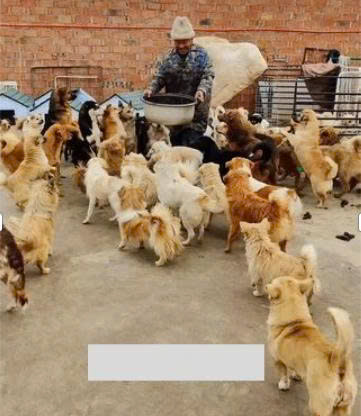
In a small, weathered hut standing quietly at the edge of a forgotten path, an elderly man lives a life most would find unimaginable. Half of his body no longer responds to his will, the lingering result of a stroke that changed everything overnight. Yet despite his physical limitations, he has taken on a responsibility that even the strongest might hesitate to accept—caring for a growing pack of stray dogs that depend entirely on him for survival. His days are slow, often painful, but never empty, because every moment revolves around the lives he chose to protect.
On this particular afternoon, the man dragged himself closer to a soot-darkened cooking pot resting near the corner of his modest shelter. The pot, once filled with hope for a warm meal, now held only a thin layer of soup clinging to its bottom. With trembling hands and visible effort, he scooped up what little remained, his movements careful but strained. Hunger was not new to him, but neither was sacrifice. Before he could even lift the spoon to his lips, the energy in the hut shifted dramatically.
The dogs had noticed.
What began as a few curious glances quickly turned into a restless frenzy. One by one, then all at once, the dogs surged forward, their eyes locked onto the small portion of soup in his hand. Their excitement was not rooted in disobedience but desperation. These animals, once abandoned, injured, or left to starve, had learned that every meal could be their last. Now, faced with even the faintest scent of food, their instincts took over, creating a chaotic scene inside the cramped space.
The man tried to steady himself, his voice weak but persistent as he called out to calm them. However, his condition made it nearly impossible to assert control. His body could not respond quickly enough, and his strength was no match for the sheer number of eager, hungry dogs pressing closer. In moments, the hut was filled with movement, paws scraping the floor, tails wagging wildly, and soft whines turning into urgent cries.
Despite the chaos, there was no anger in his eyes—only a quiet understanding.
Each of these dogs had a story, and in many ways, their suffering mirrored his own. Some had been discarded like trash, left tied to poles or wandering the streets with visible wounds. Others had simply been forgotten, surviving day by day until fate led them to this unlikely refuge. The man never turned them away, even when he barely had enough for himself. In their brokenness, he found purpose, and in his care, they found a second chance.
But moments like this revealed the harsh truth beneath that fragile balance.
There was never enough.
The thin soup at the bottom of the pot was not meant to feed many, yet it symbolized everything—the struggle, the hope, and the impossible choices he faced every single day. As the dogs crowded around him, each trying to get closer, he lowered the spoon slowly. Not in defeat, but in quiet surrender. He understood that denying them would only prolong their hunger, and perhaps, deepen their desperation.
So he shared.
It wasn’t organized or fair, and certainly not enough to satisfy them all, but it was an act of love in its rawest form. The dogs licked eagerly, some managing to taste the soup while others waited, hoping their turn would come. The man watched, his own hunger temporarily forgotten, replaced by a bittersweet sense of fulfillment. Feeding them—even in such a small, insufficient way—gave his struggle meaning.
Outside the hut, the world carried on as usual.
People passed by without noticing the life unfolding within those fragile walls. The noise of the dogs might have reached them, but few would have paused to understand its cause. In a society that often moves too fast to look back, stories like this remain hidden, tucked away in quiet corners where compassion exists without recognition.
Yet within that hut, something extraordinary persisted.
It wasn’t just about survival; it was about connection. The dogs, despite their frantic behavior, trusted the man completely. They stayed, even when food was scarce, even when conditions were harsh. In return, he gave them everything he could—his time, his effort, and the little strength he had left. Together, they formed an unlikely family bound not by comfort, but by resilience.
As the commotion slowly settled, the dogs began to lie down, their energy fading after the brief moment of excitement. Some curled up near the man, their bodies pressing gently against him as if to offer warmth and gratitude. Others rested nearby, their breathing steady, their eyes still watching him with quiet loyalty. The storm had passed, leaving behind a fragile calm.
The man leaned back slightly, exhaustion visible on his face.
Moments like this took everything out of him. Every movement, every attempt to care for his animals, came at a physical cost. Yet he never once considered giving up. To him, these dogs were not a burden, but a reason to keep going. In their presence, he found strength that his body alone could no longer provide.
His life may seem tragic to an outsider, but within that simplicity lies something deeply powerful.
He has nothing, yet he gives everything.
The scene of a paralyzed man struggling to hold onto a spoon of soup while surrounded by a pack of hungry dogs might appear chaotic, even overwhelming. But beneath that chaos is a profound story of compassion—a reminder that kindness does not depend on wealth, strength, or circumstance. Sometimes, it exists in the smallest acts, like sharing the last bit of food with those who need it most.
There are no headlines written about him, no cameras documenting his daily sacrifices.
But perhaps there should be.
Because in a world where it is easy to look away, his story challenges us to look closer. It asks difficult questions about responsibility, empathy, and the lengths we are willing to go for others—especially those who cannot repay us. It shows that even in the face of personal suffering, it is possible to create a space where life is protected and valued.
As evening approaches, the man will likely prepare another modest meal, if he has anything left to cook. The dogs will gather again, their hopes renewed with every movement he makes. And once more, he will give what he can, even if it means going without.
Not because it is easy.
But because, to him, it is the only way to live.