Mountain Collapses Before Rescue Teams Can Save Stranded Elephant Herd
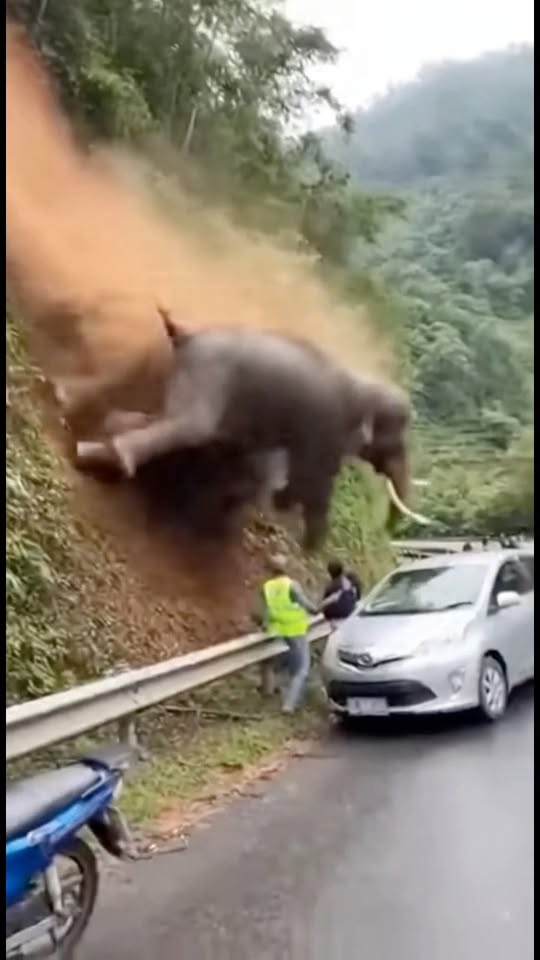
The remote mountainside had always been known for its breathtaking beauty—dense green forests clinging to steep slopes, mist rolling gently across the peaks at dawn, and the distant calls of wildlife echoing through the valleys. For generations, herds of wild elephants had roamed these highlands, navigating narrow trails carved by time and instinct. But last week, that serene landscape became the scene of an unfolding tragedy that has captured global attention.
Local villagers first noticed something was wrong when a portion of the mountainside began to shift after days of relentless rainfall. Cracks appeared in the soil, trees leaned at unnatural angles, and rocks tumbled intermittently down the slope. Among those most at risk was a small herd of elephants—adults and juveniles alike—that had been spotted grazing on a precarious stretch of land halfway up the mountain.
Authorities were alerted immediately. Wildlife officials, environmental experts, and rescue volunteers mobilized in response to reports that the herd appeared stranded on unstable terrain. The plan was urgent but delicate: monitor the elephants’ movements, assess the structural integrity of the slope, and attempt to guide the animals toward safer ground before conditions worsened.
However, nature moved faster than any rescue team could.
As preparations were underway, the mountainside suddenly gave way. Witnesses described a deafening roar that seemed to split the sky itself. A massive section of earth, loosened by days of heavy rain, collapsed without warning. Trees, rocks, and soil cascaded downward in a violent landslide, carrying everything in their path—including the herd of elephants.
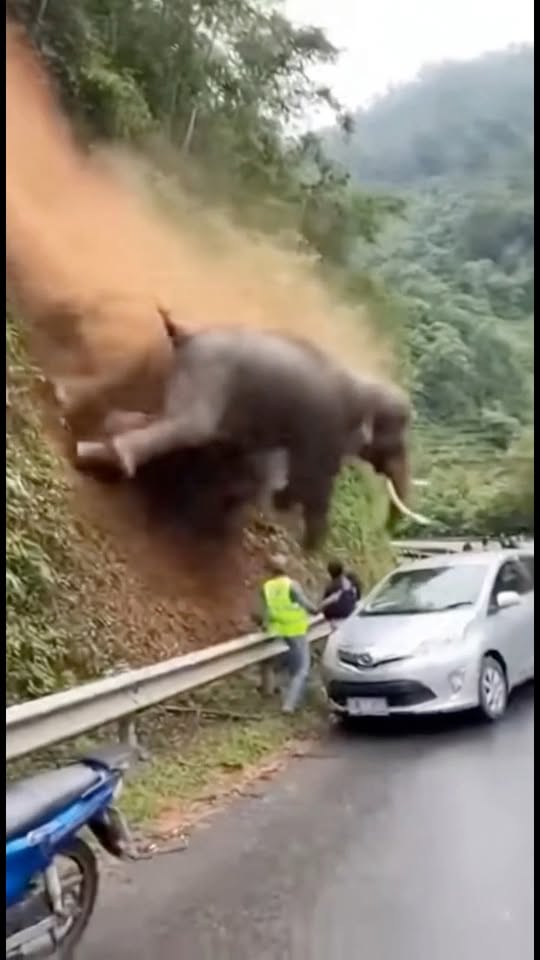
Rescue workers, positioned at a safer distance below, watched in horror as the ground beneath the animals disappeared. Some elephants tried to flee, trumpeting loudly as they struggled to maintain footing on the shifting earth. But the collapse was too swift and too powerful. Within seconds, the mountainside transformed into a torrent of mud and debris.
The immediate aftermath was chaotic and heart-wrenching. Thick clouds of dust and mud obscured visibility. The once-green slope was reduced to a scar of brown earth stretching down into the valley. Emergency responders rushed forward as soon as it was deemed safe, carefully navigating unstable ground to search for signs of life.
Initial reports confirmed that several elephants had fallen a significant distance. While exact numbers are still being verified, wildlife officials acknowledged that the herd suffered severe losses. Some animals were found partially buried under layers of soil and fallen timber. Others lay injured at the base of the slope, struggling to move.
Veterinary teams worked tirelessly under challenging conditions. Heavy machinery was brought in to remove debris, but operators were forced to proceed with extreme caution to avoid causing further harm to any surviving elephants trapped beneath the rubble. Each movement required careful coordination between engineers and wildlife specialists.
One particularly emotional moment unfolded when rescuers discovered a young calf pinned beneath a fallen tree. The animal’s mother, injured but alive, remained nearby despite the chaos, refusing to abandon her offspring. Witnesses described her low, mournful calls as rescuers worked to free the calf. After hours of delicate effort, the team managed to extract the young elephant, though both mother and calf required immediate medical attention.
Environmental experts have pointed to a combination of factors that likely contributed to the disaster. Prolonged rainfall had saturated the soil, weakening the mountain’s structural stability. Deforestation in surrounding areas may have exacerbated erosion, reducing the natural support provided by deep-rooted vegetation. Climate patterns in the region have also become increasingly unpredictable, leading to more frequent and intense storms.
Local authorities emphasized that the rescue operation had been complicated by the terrain’s inaccessibility. The herd’s location on a steep, remote slope limited the speed at which teams could reach them. Helicopter assistance was considered but ultimately deemed too risky due to low visibility and unstable air currents near the collapsing area.
Community members gathered at the edge of the valley in the days following the collapse, many expressing grief and disbelief. Elephants have long held cultural and ecological significance in the region. They are seen not only as majestic creatures but as vital architects of the forest ecosystem, helping to disperse seeds and maintain biodiversity.
“This is not just a loss of animals,” one local conservation volunteer said. “It is a loss for the entire landscape. These elephants were part of our mountains.”
International wildlife organizations have since offered support, pledging resources to assist with ongoing rescue and rehabilitation efforts. Teams continue to monitor the site for additional instability, as smaller secondary landslides remain a threat. Drones equipped with thermal imaging cameras are being used to scan for any remaining survivors that might be trapped in inaccessible pockets of debris.
The tragedy has reignited discussions about the delicate balance between wildlife habitats and environmental pressures. Conservationists argue that stronger measures are needed to protect mountainous ecosystems, particularly as climate change intensifies weather extremes. Reforestation initiatives and improved land management practices are now being urgently reconsidered.
In the meantime, veterinarians are focused on stabilizing the injured elephants. Temporary field clinics have been set up near the base of the mountain. Some animals have sustained fractures, internal injuries, and severe stress-related symptoms. Specialists in elephant behavior are also present, recognizing that the psychological impact on surviving herd members can be profound. Elephants are highly social animals with strong familial bonds, and the sudden loss of companions can lead to long-term behavioral changes.
Footage from the scene, shared by local media, has sparked an outpouring of sympathy worldwide. Social media platforms have been flooded with messages of support, with many calling for increased global attention to wildlife safety in disaster-prone regions.
Government officials have announced a formal investigation into the circumstances leading up to the collapse. While natural causes are considered the primary factor, authorities aim to determine whether human activity in nearby areas contributed to soil instability. The findings may shape future policies regarding land use and conservation zoning.
As recovery efforts continue, the mountainside remains a stark reminder of nature’s unpredictable power. What was once a thriving habitat now bears visible scars—uprooted trees, exposed rock, and deep fissures etched into the earth. The air still carries the scent of damp soil and broken vegetation.
Yet amid the devastation, small signs of resilience are emerging. Surviving elephants have been observed staying close together, moving cautiously but steadily under the watchful eyes of conservation teams. Their presence offers a fragile sense of hope that life, even after such profound loss, endures.
Experts stress that long-term restoration will require coordinated action. Replanting native vegetation, reinforcing vulnerable slopes, and establishing early-warning systems for landslides are among the measures being discussed. Wildlife corridors may also be reassessed to guide animals away from high-risk areas during severe weather events.
For now, the focus remains on healing—both the land and the creatures who call it home. The rescue that teams had hoped to carry out before disaster struck was overtaken by forces beyond human control. The mountain collapsed before the elephants could be brought to safety, and in that sudden moment, a tranquil landscape was transformed into a site of sorrow.
As the region mourns, many are left reflecting on the fragile connection between wildlife and the environments they depend on. The fallen mountainside stands as a powerful testament to that vulnerability—and to the urgent need for vigilance in protecting the natural world.
While the full toll of the collapse may take time to understand, one thing is certain: the memory of the elephants who were lost will linger long after the dust has settled.